Most people who ask this question are really asking something more specific: Is it so hard that I might fail?
It is a reasonable answer to seek before investing a week of your life and several thousand dollars in a liveaboard sailing course. It deserves a straight answer.
Here it is: sailing is genuinely challenging to learn well. It is not, however, the kind of challenge that filters out most people who try. The difficulty is real but it is structured — meaning it arrives in predictable forms, at predictable stages, and responds well to good instruction and consistent practice.
What makes sailing feel or appear harder than it actually is, for most beginners, is that several different types of learning are happening simultaneously. What makes it more achievable than it looks from the outside is that each of those types of learning responds quickly to time on the water.
How Hard is Sailing? The Three Layers of Difficulty
Sailing is not uniformly difficult. It has distinct layers; understanding which layer you are working on at any given moment makes the challenge more manageable.
Layer 1: Physical Familiarity With a Moving Environment
The first challenge of sailing has nothing to do with sailing. It is simply learning to exist comfortably on a boat that is moving.
A sailing vessel underway is in constant motion. The deck tilts. The horizon moves. Tasks that are trivial on land — pouring a cup of coffee, walking from one side of the room to the other, reading a chart — require adaptation on a boat. For most people this adaptation takes between 24 and 48 hours. By day two of a liveaboard course, students who were tentative and unsteady on day one are moving around the boat with confidence.
This layer of difficulty is temporary and almost universal. It is not a signal of how well you will ultimately sail. It is simply the cost of entry to the environment.
Layer 2: Technical Vocabulary and Conceptual Understanding
Sailing has a specific vocabulary — terms for parts of the boat, for points of sail, for maneuvers — and a set of underlying concepts about how wind interacts with sails to produce movement. These must be learned before the physical skills can be practiced meaningfully.
For most adults, this layer is moderately challenging in the way any new technical vocabulary is challenging: it requires attention and repetition, but it is not conceptually difficult. Yes, you will scratch your head and ask “How did they come up with THAT term?” for a few of them, but maybe the ensuing jokes will help the term stick. The physics of how a sail generates lift, how the relationship between boom angle and wind direction affects speed, how tides and currents interact with a planned passage — these are understandable to any adult who engages with them. They are not intuitive at first – they become intuitive with practice.
The most common frustration here: the vocabulary feels overwhelming in the first day or two, and then it doesn’t. Students consistently report that by the third day of a liveaboard course, terminology that felt foreign on day one has become natural. The brain adapts faster than it feels like it will.
Layer 3: Judgment and Decision-Making Under Real Conditions
This is the hardest layer and the one that takes the longest to develop. It is most often underestimated by beginners and overestimated by people who have never sailed.
Sailing judgment is the ability to read a situation — wind, sea state, boat behavior, crew capability, weather forecast, anchorage conditions — and make good decisions under time pressure, potential physical and mental fatigue, sometimes when conditions are changing faster than expected.
This is hard in the way that any high-stakes decision-making under uncertainty is hard. It does not come from reading books or passing tests. It comes from accumulated experience — from making decisions, observing the consequences, and adjusting the mental model accordingly. Over and over, in different conditions, on different boats, in different waters.
No course gives you this directly. What a good course gives you is a structured foundation from which this judgment can develop. The judgment itself accumulates over years, not weeks. This is not a limitation of courses — it is simply the nature of how judgment in any complex skill develops. Understanding this clearly at the start is what separates students who continue growing after a course from those who only plateau.
What Specifically Gets Hard at Each Stage
When asking “how hard is it to learn to sail” Beyond the three layers, there are specific skills that beginners consistently find difficult. Knowing what they are in advance tends to reduce their impact.
Docking and maneuvering under engine in close quarters.
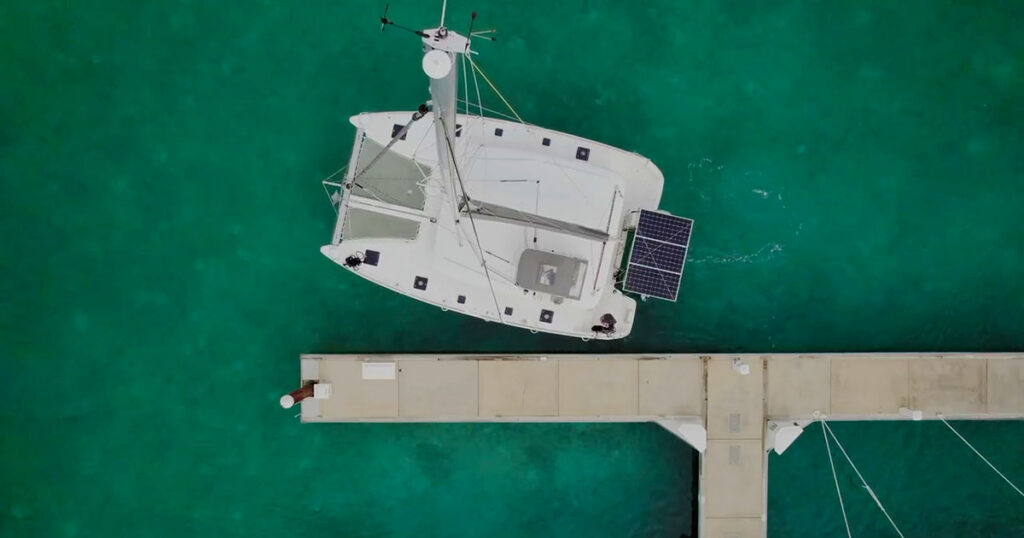
This is the skill most students name as the hardest and voice the most concern when they face the task. A 44-foot sailboat does not stop and turn like a car. In a crowded marina, with other boats nearby, wind pushing the hull, and a dock crew watching (not to mention every other sailor on their own vessel), the pressure is real. This skill requires practice, patience, and a willingness to make mistakes. It does not come quickly, and instructors who tell you otherwise are not being straight with you. Plan to spend deliberate time on this and expect it to feel uncomfortable before it feels controlled.
Tacking and gybing in sequence under pressure
Individual tacks are learnable quickly. Executing a sequence of tacks to make progress against the wind, while managing sail trim, monitoring traffic, and thinking about the next three moves — with a gust or a wind-shift arriving at the wrong moment — is a different order of difficulty. It becomes manageable with repetition.
Reading wind on the water
Charts and instruments tell you a great deal. So does the surface of the water — the texture of the chop, the dark patches that indicate gusts, the way the sea flattens in a lee. Learning to read these signals is a skill that develops gradually and is one of the more rewarding aspects of becoming a real sailor. It takes time, and it is not taught well in all courses.
How hard is it to learn to sail in the night
For students who encounter it during a liveaboard course, the first night passage brings a surge of anxiety and is frequently described as the single most challenging moment of the week – but it is also deeply exhilarating. The boat behaves identically. The chart looks the same. But the visual references that made navigation feel manageable disappear, and new ones — lights, the feel of the wind, the sound of the water — have to substitute. It is disorienting at first, then with experience, this initial tension gives way to one of the most rewarding times on the water. If your course includes a night passage, lean into it rather than away from it.
Managing the unexpected
A course teaches you procedures. The sea specializes in situations that don’t follow procedures. An anchor that drags at 2am. A squall that arrives faster than the forecast suggested. An engine that won’t start on approach to a busy dock.
What distinguishes good sailing instruction from great sailing instruction is this: a great course doesn’t just teach you what to do when things go wrong — it deliberately creates moments where you have to figure it out yourself, with the safety net of an experienced instructor still present. A well-designed curriculum will put students in command of the boat mid-week — setting a route and then stepping back to observe — precisely because that moment of real responsibility, while support is still available, is when the most important learning happens. By the time you’re sailing independently, you’ve already practiced making real decisions under real pressure. The unexpected becomes less unexpected.

What Makes It Easier Than It Looks
1.The learning curve is steep and then it levels
The volume of new information in the first two days of a sailing course can feel genuinely overwhelming. By day four, the same students are typically handling the boat with visible confidence and beginning to internalize the decision-making framework. The initial steepness of the curve does not predict final difficulty.
2.You are always in contact with the physical consequences of your actions
Sailing is unusually good at teaching because the feedback is immediate and concrete. Trim the sail correctly and the boat accelerates and steadies. Trim it incorrectly and the sail flaps and the speed drops. This directness of feedback means that good decisions are reinforced physically, not just intellectually. Students who engage actively — who try things and observe the results rather than waiting to be told — tend to improve faster than their own expectations.
3. Good instruction makes an extraordinary difference
The difficulty of learning to sail is not set in stone. It is heavily dependent on the quality of instruction. The distinction is worth understanding: a great instructor is not simply an experienced sailor who explains how a sailboat works. They are someone who has studied how people learn, who knows how to sequence skill development so that each day builds on the last, and who deliberately transfers responsibility to students rather than protecting them from it.
A course designed around this principle looks different from the outside — students at the helm earlier, more complex decisions introduced sooner, structured moments of independence before the course ends. This is what accelerates learning, and it is what separates instruction that builds lasting capability from instruction that produces a certification and not much else.
The instructor matters more than the destination, the boat, or the certification being pursued.
4. Structured systems reduce the cognitive load that beginners find hardest
One of the most consistent findings from beginner sailors across forums and sailing communities is that procedural overwhelm — remembering everything that needs to happen when getting underway, anchoring, or returning to a marina — is among the hardest practical challenges of early sailing. The solution experienced sailors use is not exceptional memory. It is structured checklists and daily routines that turn complex multi-step procedures into repeatable habits. A well-designed course builds these systems into the daily rhythm from day one — equipment checks, weather observation logs, engine inspections, passage planning worksheets — so that by the end of the week students have not just learned skills but internalized the organizational frameworks that make those skills reliable under pressure. This is the difference between knowing what to do and being able to do it when it matters.
How Hard is it to Learn to Sail? An Honest Summary
Learning to sail is harder to learn than a weekend activity and easier to learn than most people fear before they start.
The early stages — getting comfortable on the boat, learning the vocabulary, developing the feel for wind and sail — respond quickly to immersive instruction and time on the water. Most adults who commit to a week of good liveaboard instruction come away genuinely capable at this level.
The deeper stages — the judgment, the seamanship, the composure when things don’t go to plan — take longer. They cannot be rushed or shortcut. They develop through accumulated experience over months and years, and there is no substitute for that accumulation.
This is not a reason to be discouraged. It is a reason to choose the right starting point — one that builds a real foundation — and then stay on the water consistently enough to build on it. Sailing is one of those rare pursuits where the difficulty is proportional to the reward, and where the learning genuinely never stops. Every sailor, at every level, is still becoming the sailor they want to be.
The question is not “how hard is it to learn to sail”. The question is whether you are willing to engage with this kind of difficulty to reap the rewards. For most people who have seriously considered learning to sail, the answer tends to be yes — once they understand what they are actually signing up for.
For a complete guide to the learning process and finding the answer to “how hard is it to learn to sail”— pathways, timelines, certifications, and how to choose the right school — read: How to Learn to Sail as an Adult: The Complete Guide.
Related reading: