Are you dreaming of learning how to sail? Sailing is an AMAZING platform for adventure, discovery and exploration!
Perhaps you’ve been watching sailing video blogs of couples and families sailing around the world and wonder if this could be you?
If you are reading this, you’re probably thinking something along the lines of:
“I would love to learn to sail… but how do I even start?“
“Is it too late for me to learn to sail?“
“Can I actually become competent and captain a sailboat?“
YES, YOU CAN LEARN TO SAIL AND EMBARK ON SAILING ADVENTURES OF YOUR OWN!
This guide will give you a roadmap of how to confidently embark on your own sailing journey and covers:
- What is takes to learn to sail
- The fastest path to competent
- The mistakes most beginners make
- How to choose the right course and sailing school
THE REALITY MOST SAILING SCHOOLS WON’T TELL YOU
Here’s the uncomfortable truth:
Sailing is not hard, but becoming independently capable is a journey.
You can take a course, pass your certifications and log a few days on the water and still not be ready to charter a boat or buy your own boat and cast off the dock lines.
This gap is where most beginners get stuck. The first step is to clearly define your goals, have realistic expectations and know the roadmap you need to take.

1. WHAT ARE YOUR SAILING GOALS AND DREAMS? WHAT DOES “LEARNING TO SAIL” LOOK LIKE FOR YOU?
Over the years, we’ve found that most folks fall into one of three categories.
CASUAL EXPERIENCE
- Will sail occasionally
- Enjoy being part of a crew
- Love the experience of being on a boat and on the water!
This is the LOWEST COMMITMENT and LOWEST SKILL REQUIREMENT TO LEARN TO SAIL
CHARTER COMPETENCE
- Want to rent/charter a boat in international locations
- Want to sail with family or friends in exotic destinations
- Want to have the skills and knowledge to safely captain a charter vessel
Requires real, applied skill, knowledge, certifications and experience
SAILBOAT OWNERSHIP/LONGTERM CRUISING
- Plan on buying a boat
- Will live aboard for extended periods, sailing longer distances
- Need advanced experience managing onboard systems, passage making and deep experience
Requires layered competence over time, in a variety of vessels, locations and conditions
If your goal is #2 or #3, you need to approach your sailing training differently. Your journey from newbie to confident sailor will require more time on the water, more training and a more in depth roadmap to meet your goals. Most beginners underestimate this.
2. UNDERSTAND THE SKILLS AND KNOWLEDGE YOU ACTUALLY NEED TO LEARN
Sailing isn’t one skill. It’s a complex web of knowledge and skills. The first step is to gain the knowledge, skills and certifications that will give you a license to learn to sail. Once you have your license, you can then dive into opportunities to deepen all you know.
To become competent you first need knowledge and working ability in:
BOAT HANDLING
- Maneuvering in close quarters under engine power
- Docking (in wind, current and tight spaces)
- Steering under sail
SAIL MANAGEMENT
- Raising, unfurling/furling, trimming and reefing
- Understanding wind angles and the points of sail
- Adjusting sails for performance and safety
NAVIGATION
- Using Navionics and electronic navigation tools
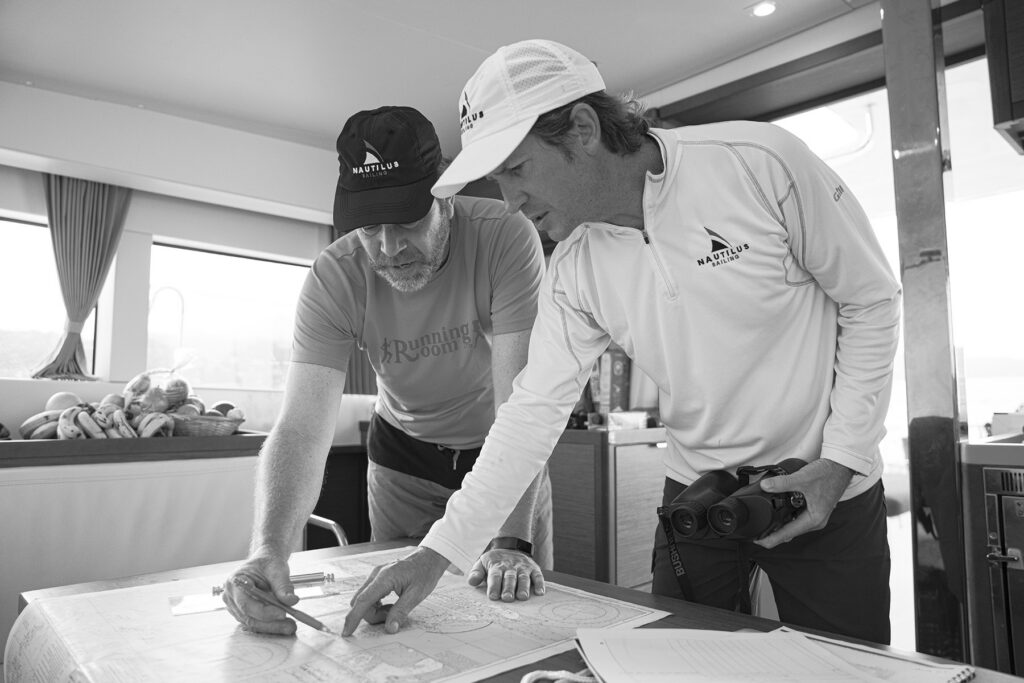
- Understanding paper charts, plotting, headings, and distances
- Visual navigation and avoiding hazards
- Buoys and daymares
ANCHORING AND MOORING
- How to choose an anchorage (shelter, quality of the bottom, hazards and room to swing)
- How to set and retrieve an anchor, proper scope, testing an anchor, anchor alarms
- How to pick up and tie off to a mooring
SYSTEMS & LIVING ABOARD
- Managing electrical, water and fuel systems
- Galley, heads, refrigeration and daily life onboard
- Troubleshooting problems
SEAMANSHIP AND DECISION MAKING
- Rules of the road
- Keeping a right ship
- Weather interpretation and planning
- Risk Assessment
- Crew management
Most courses will teach you pieces of this, but few go through in an in depth, systematic fashion! Very few courses will insure you have a solid foundation when you learn to sail.
3. CHOOSE THE RIGHT LEARNING PATH
There are three main ways to learn to sail. Each has it’s trade offs.
LOCAL/DAY SAILING SCHOOL | LIVEABOARD COURSES | DIY LEARNING (BUY A BOAT AND GO) | |
| FORMAT | – Day at a time on the water, typically on weekends – Can go home each night | – 7 days living on a – boat sailing in international waters – Full immersion – Small groups | – Learn by doing – Informal Mentorship |
| PROS | – Lower cost – Convenient – Good, basic introduction and exposure to sailing and boats | – Continuous learning (not just class hours) – Real world conditions – Rapid skill development – Decision making exposure | – Flexible – Real World exposure |
| CONS | – Limited immersion – Minimal deep experience as you are typically in sheltered, coastal waters – Can take 6 months to a year to get through basic certifications – Typically not enough for competence | – Higher up front cost – Intense learning curve – Requires time to prepare for the course (studying materials) | – High risk of knowledge gaps – Slower progress – Potentially expensive mistakes |
4. SAILING CERTIFICATIONS: ASA, RYA and OTHERS
If you are planning to learn to sail and charter boats internationally or your goal is to become a world cruiser on your own boat, you will need formal sailing certifications. All the major charter companies now require that you have sailing certifications, which confirm you have gone through a rigorous, structured training program and have the necessary skills and experience to meet insurance requirements to learn to sail and charter vessels.
In the same way, to obtain insurance for a private vessel, more and more insurance companies want to see formal sailing certifications or they may require that you have a paid, professional captain onboard your vessel.
Many countries have their own formal sailing certification entity. In the United States, it’s American Sailing and US Sailing, in Canada it’s the Canadian Yachting Association (CYA) and in England it’s the Royal Yachting Association (RYA)
Two of the most respected entities globally for most charter companies and insurance providers are American Sailing and the RYA.

| AMERICAN SAILING | ROYAL YACHTING ASSOCIATION (RYA) |
| Modular: Basic Keelboat Sailing – ASA 101, Basic Coastal Cruising ASA 103, Bareboat Charter ASA 104 and Cruising Catamaran ASA 114). These four certifications for the basis for doing international charters | More hierarchical: Competent Crew, Day Skipper, Coastal Skipper, Yachtmaster Coastal, Yachtmaster Offshore and Yachtmaster Ocean |
| Common in US and Caribbean | Strong international learn to sail reputation |
| Focused more on recreational sailors | More formal and rigorous training |
| Can be completed in a 7 day live aboard learn to sail course | Industry standard for professional mariners |
| Courses to charter can take 6-8 months to complete |
Which certification is right for you? It depends entirely on your personal goals! If you are a recreational sailor wanting to do charters or plan on buying your own boat, the American Sailing courses are a great foundation and the fastest path to start chartering. However, if you are desiring a much more rigorous program and may want to work commercially in sailing, then the RYA certifications may be more appropriate.
5. WHAT GOOD TRAINING LOOKS LIKE
If your goal is competence, your training should include:
- Opportunities to practice and repeat skills, and not just demonstrations
- Hands on responsibility and opportunities to take the helm, dock, anchor, moor, raise and trim sails, do systems checks, etc…
- Instructor involvement: You want an instructor that will offer feedback, correction when needed and will step back to empower you.
- Small group size: Any more than 4 people on a course starts to dilute the learning experience
- Real world scenarios and conditions: Are you practicing in calm, perfect conditions or in stronger winds with big ocean swells?
If your courses doesn’t include all these you may be getting EXPOSURE and not SKILL BUILDING OPPORTUNITIES!
6. HOW LONG DOES IT ACTUALLY TAKE TO LEARN TO SAIL?
Here’s the honest answer:
| BASIC FAMILIARITY | 2-5 Days |
| FUNCTIONAL COMPETENCE | 5-10 Days |
| TRUE COMPETENCE | 6 Months – 2 Years |
THE FASTEST PATH MOST ADULTS TAKE: An intensive week long live aboard course followed by independent experience on flotillas, offshore trips and charters.
7. THE BIGGEST MISTAKES BEGINNERS MAKE
- CHOOSING CONVENIENCE OVER IMMERSION: Short, local courses feel easier but can delay real progress.
- Overvaluing Certification: A certificate does not necessarily equal competence!
- Avoiding responsibility during training: If you’re not participating and practicing the skills, you won’t learn to sail.
- Waiting too long to apply your new sailing skills: Ideally you should do your first charter, to reinforce all your knowledge and skills within 6 months to a year of a live aboard course, or you will forget lots!
- Underestimating decision making” A HUGE part of learning to sail is actually learning to make critical decisions and the judgement you will learn.
8. HOW TO CHOOSE THE RIGHT SAILING SCHOOL AND COURSE?
The school and course you choose will depend on your personal sailing goals! There is no once size fits all approach.
Some of the key things to look at when choosing a sailing school:
- What are their reviews on Trip advisor and Google like? Don’t just look at the stars read through comments to find out about their instructors, the boats you’ll learn to sail on and the overall experience.
- Has the school been recognized in any major publications that confirm the quality of their programs and their authority in the industry?
- Is the school accredited? Both charter companies and insurance companies want to see that a sailing school is officially accredited!
- What’s the school’s background? Do they have any training in education?
- What is the ethos of the school and what is their target demographic?
- How many students will be onboard? Any more than 4 means less time at the helm and practicing skills.
- What boats do they use? Typically newer boats means less potential problems and interruptions to your course.
- Location: Choose a location that matches the area you ultimately plan to learn to sail in and offers more challenging conditions, from stronger winds to larger ocean swells.
- Price: What exactly is included in your course fee? What will your experience and the quality of your education be?
CONCLUSION
Learning to sail can be an amazing experience and open up some incredible opportunities! However, you need to be clear about your own goals, and then craft a path that will help you achieve those dreams. Do you want exposure or competence? Do you want to sail occasionally or be able to charter and captain your own vessel? You can go from newbie to confident captain if you choose immersive training and learn to sail with hands-on responsibility in real-world conditions, and then follow up with opportunities to practice on your own.