One of the most common questions people ask us before setting out to learn how to sail is:
“CAN ANYONE LEARN HOW TO SAIL?”
Our short answer is:
Almost anyone can learn how to sail.
Our better answer is:
Almost anyone can become a competent sailor if they are willing to learn, participate, and practice.
Contrary to popular belief, you do not need to:
- Have grown up around boats
- Be exceptionally athletic
- Be young
- Come from a sea-faring family
- Have prior experience on the water
Every year, thousands of adults learn to sail from scratch, beginning at a wide variety of ages; 20s through 60s, and beyond.
We have found that what matters far more than experience, strength, or age is, quite simply, your willingness to learn how to sail.

THE BIGGEST LEARN HOW TO SAIL MYTH
We come across many aspiring sailors who have previously assumed that sailing is highly technical and therefore prohibitively difficult.
That misconception often comes from watching experienced sailors zip around their boats, performing tasks that look foreign and complex.
In reality, sailing is made up of many simple skills that are learned one at a time:
- Steering a course
- Trimming sails
- Reading the wind
- Docking
- Anchoring
- Navigating
- Developing weather awareness
None of these skills are especially difficult on their own. Proficiency with each is very possible. And as your competence grows, your confidence emerges!
The challenge is learning to integrate these building blocks of sailing so that they complement each other. That is exactly what Nautilus’ hands-on, immersive, real-world training is designed to accomplish.
WHAT TYPE OF PERSON LEARNS HOW TO SAIL MOST SUCCESSFULLY?
Surprisingly, the people who learn fastest are rarely the people with the most “know-how”. Truly! You don’t need prior experience.
We’ve noticed that the most successful students usually share a few characteristics:
Curiosity
They ask questions.
They want to understand not only what to do, but why.
Humility
They are comfortable making mistakes.
We’ve seen learning happen swiftly when students are willing to receive correction and adjust.
Participation
They volunteer for tasks.
They take the helm.
They dock.
They anchor.
They try things instead of watching someone else do them.

Patience
Sailing is not a collection of tricks.
It is a decision-making process that improves with repetition … persistence pays off!
What Age is Too Old to Learn how to Sail?
For most people:
There is no age limit.
Some of the most capable sailors begin later in life.
In fact, older students often bring the advantages of:
- Better judgment
- More patience
- Greater risk awareness
- Stronger communication skills
Learning to sail is far less dependent on physical ability than many people imagine.
Modern cruising sailboats have the added bonus of:
- Winches
- Mechanical advantage
- Electric windlasses
- Engine-assisted maneuvering
Technique is usually more important than strength.
Do You Need to Be Physically Fit?
You do not need to be an athlete.
However, sailing does involve:
- Moving around a boat safely
- Stepping between levels
- Pulling lines
- Maintaining balance
Most reasonably healthy adults can enjoy participating in the adventure of getting under sail comfortably.
If you have physical limitations, discuss them with the sailing school beforehand. Good instructors can often adapt training methods and assignments.
What If You’ve Never Been on a Boat Before?
Know what? This is actually very common!
Many of our Nautilus students arrive at the dock having:
- Never sailed
- Never driven a boat
- Never anchored
- Never read a chart
Good sailing instruction assumes no prior knowledge.
The purpose of a beginner course is not to test existing knowledge.
It is to build it.
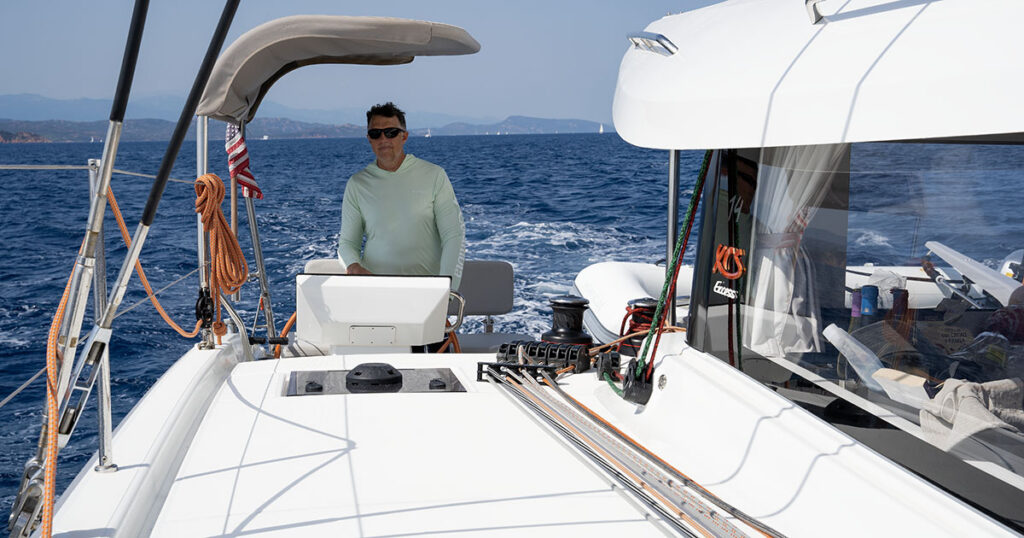
Why Some People Struggle
While almost anyone can learn how to sail, some people make the process much harder than it needs to be.
The most common obstacles are:
1.Fear of Making Mistakes
Students sometimes avoid stepping up to take control of the boat because they are worried about doing something wrong. You are learning and real learning doesn’t assume perfection on first try!
Ironically, mistakes are one of the fastest ways to learn.
2. Staying Passive
Watching someone else sail feels productive.
It is not.
Familiarity & ability comes from doing.
3. Expecting Instant Confidence
Confidence comes after competence.
Competence comes after repetition.
The order matters.
4. Information Overload
A student learning to sail can sometimes feel like they are drinking from a fire hydrant; there’s new vocabulary, new mechanisms, new skills, new information. They put themselves under pressure to learn everything at once.
The best approach is to watch our instructional videos before you first step onto the boat, focus on today’s lesson and allow skills to build naturally.
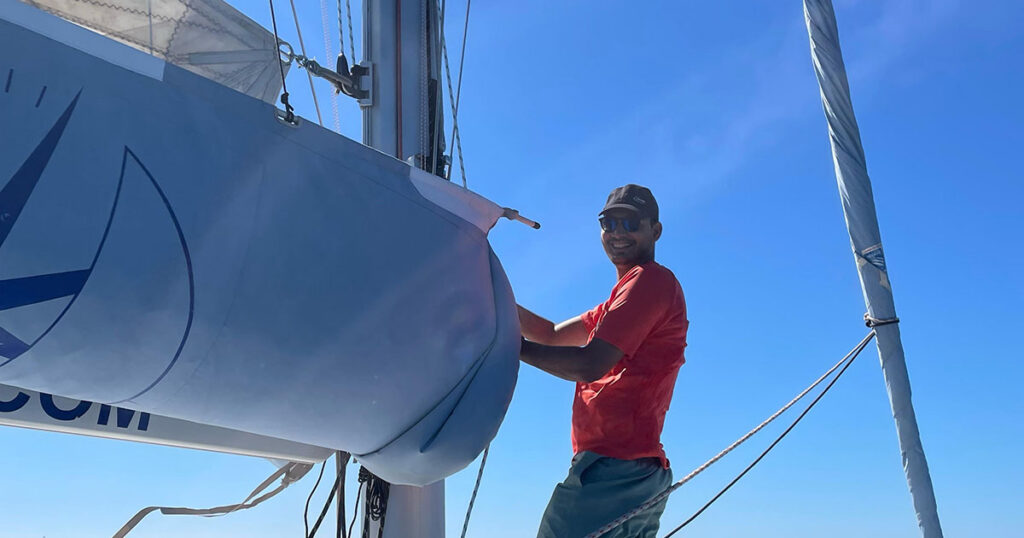
THE FASTEST WAY TO LEARN HOW TO SAIL
If your goal is to become capable as quickly as possible, look for training that includes:
- Daily hands-on sailing
- Small student-to-instructor ratios
- Docking practice
- Anchoring practice
- Navigation exercises
- Real-world decision making
Most importantly:
Choose a program where you are expected to actively participate.
Sailing is not a spectator sport.
WHAT DOES SUCCESS ACTUALLY LOOK LIKE?
By the end of quality introductory training, many students can:
- Steer confidently under sail
- Handle basic sail trim
- Anchor safely
- Navigate simple passages
- Understand weather forecasts
- Assist with docking
- Function as valuable crew
With continued practice, many progress to:
- Chartering sailboats
- Leading family cruising vacations
- Participating in flotillas
- Owning boats
- Making offshore passages
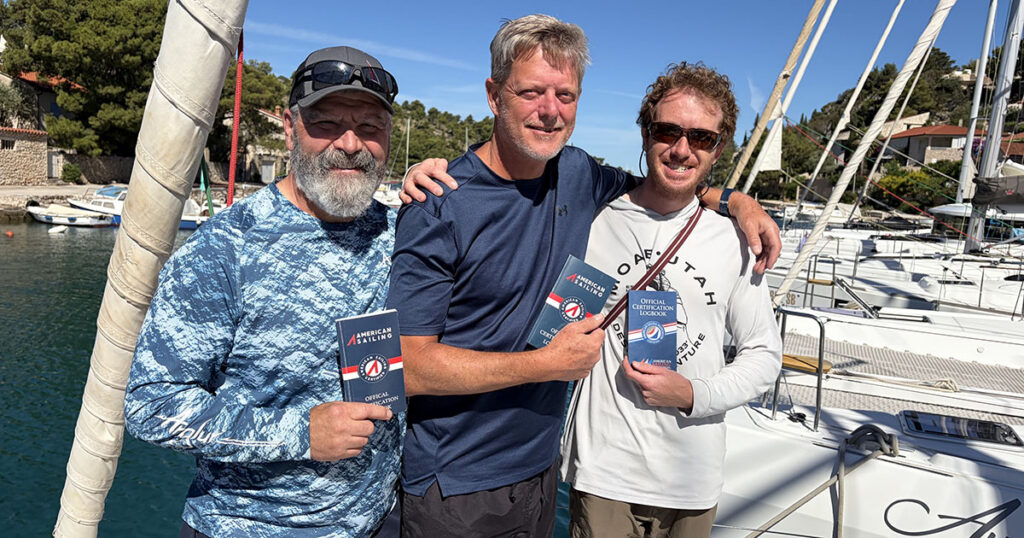
THE REAL QUESTION
The question is not:
“Can anyone learn how to sail?”
The question is:
“Are you willing to be an active participant in the learning process?”
If the answer is yes, your chances of success are extremely high.
You do not need talent.
You do not need a boating background.
You do not need years of experience.
You simply need a willingness to learn, practice, and take responsibility.
That is how sailors are made.
NEXT STEP
If you’re considering learning to sail, the next question most people ask is:
How Hard is it Actually?
Read next: How Hard Is It to Learn to Sail?
For a complete guide to the learning process and finding the answer to “how hard is it to learn to sail”— pathways, timelines, certifications, and how to choose the right school — read: How to Learn to Sail as an Adult: The Complete Guide.
Related reading: