By: Tim Geisler
It is not a small decision to choose a sailing school. It is the foundation of everything that follows – every anchorage you’ll pick, every passage you’ll plan, every moment of confidence you’ll feel with your hand on the helm in weather you didn’t expect. Get the foundation right, and the rest of the journey opens up. Get it wrong, and you spend years working around gaps that never needed to exist.
Here are ten things worth taking seriously before you choose a sailing school and enroll.
1. Reviews – TripAdvisor and Google
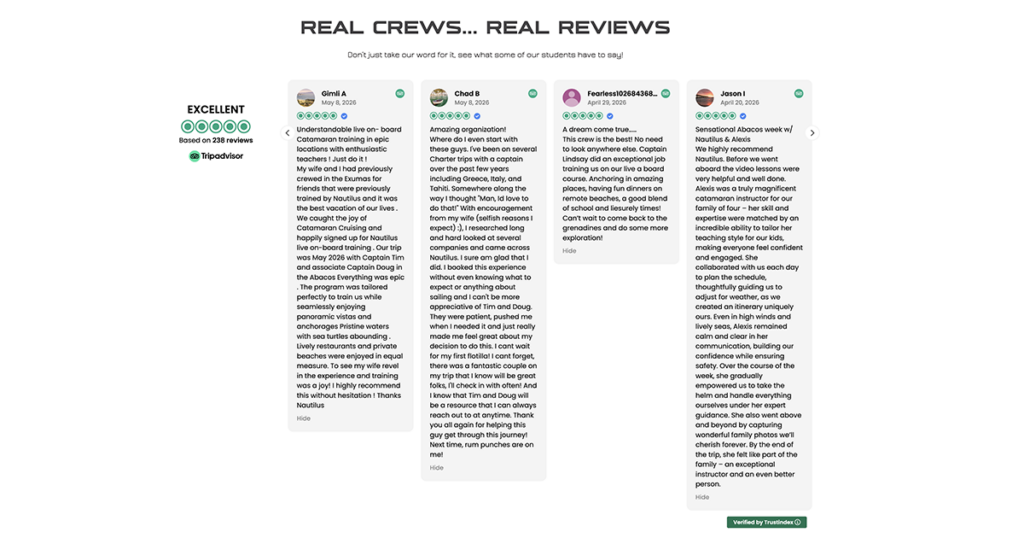
Start with what other students actually say, not what a website claims. TripAdvisor and Google reviews tend to surface the details that matter most: how instructors actually behaved on the water, whether the boat matched the brochure, whether people left feeling capable or just entertained.
When you choose a sailing school, don’t just look at the number of stars, read through a sampling of reviews and look for trends!
Patterns across many reviews are more telling than any single glowing testimonial.
2. Authority – Featured in Major Sailing Publications
Has the school been recognized by respected sailing magazines and publications? This isn’t about chasing prestige for its own sake. It’s a signal that people outside the school’s own marketing have looked closely at what they do and found it credible.
When you choose a sailing school, ask yourself: has the school been featured in major sailing magazines like Cruising World, Sail Magazine, Yachting World, Sailing Magazine, etc… Any other top tier recognition that speaks to the quality of their programs? Articles in credible magazines speak volumes as to a school’s professional reputation.
3. Instructors Who Can Actually Teach
Being an accomplished sailor and being an effective teacher are two very different skills, and conflating them is one of the most common mistakes people make when choosing a school. You want instructors who are educators first, sailors second.
Quality instructors are patient, can adapt to different learning styles, and can break complex concepts – navigation, sail trim, docking under pressure – into pieces a beginner can actually absorb.
A brilliant sailor with no gift for teaching will leave you further behind. When you choose a sailing school with a talented and gifted teacher, it will give you a firm foundation for a successful sailing journey.
4. Background and History of the School
Who built this school, and why? Are the founders educators as well as sailors? Do they have any formal training in curriculum design or running educational programs?
When you choose a sailing school built by people who understand how people learn – not just how to sail – it tends to produce a fundamentally different outcome than one built purely around sailing credentials.
5. Accreditation by a Recognized Sailing Institution
Look for accreditation from a globally recognized body – American Sailing, the RYA, the CYA, or similar – along with formal certification. Charter companies and insurers increasingly require it.
There’s been a wave of new “schools,” many with roots in YouTube sailing content, offering courses without any accreditation behind them. That can still be valuable experience and a good way to build sea miles, but if certification is part of your goal, an accredited school is the only path that gets you there.

6. The School’s Ethos
Every school has a personality, whether it says so or not. Who is the target student – people 35-60, people over 60, or people in their 20s and 30s?
Does the culture lean toward serious fun with Yacht-Week energy, or toward rigorous, structured instruction?
Neither approach is wrong, but the fit matters enormously. Choose a sailing school whose culture matches what you actually want out of the experience, not just what you think you should want.
7. The Boats You’ll Train On
What size are the boats? Monohulls or catamarans? How old is the fleet, and what systems are aboard – air conditioning, a water maker, additional sail configurations like a Code 0 or gennaker? Typically, a newer boat means less possible issues and breakages during your time aboard, and therefore more time to focus on practicing skills and learning.
The boat you train on shapes the boat you’ll feel confident chartering afterward. If your goal is to eventually charter a modern catamaran in Croatia, training on an aging 30 foot monohull won’t build the specific competence and comfort you’re after.
Charter companies look at your sailing resume to see if you have vessel experience on the same size and type of vessel you are wanting to charter. It’s thus super important, when you choose a sailing school, to learn on the type and size of vessel that you will ultimately be chartering, to meet this experience requirement.

8. Group Size
Smaller classes mean more time at the helm and more direct attention from your instructor. As class size grows, the quality and depth of instruction almost always shrinks.
When you choose a sailing school, ask directly how many students will be aboard – it’s one of the simplest predictors of how much you’ll actually learn.

9. Location and Conditions
Match the location to the kind of sailing you actually want to do. Dreaming of mountain lakes? Train on one. Want to sail U.S. coastal waters? A course in California, Florida, or Texas makes sense. Planning to charter internationally? Training in an international destination gives you experience that charter companies will recognize and trust.
One detail that’s easy to overlook: check how consistent the wind actually is in that location, during the specific time of year you’ll be there. A small number of schools schedule courses in places and seasons with unreliable wind simply because it’s convenient or cheap to run. It’s very hard to build real sailing competence – decision-making, sail trim, boat handling – in no wind.
10. Price and Value
You generally get what you pay for. There is a wide range when you choose a sailing school, from budget to premium, not unlike the travel industry itself. A backpacker’s hostel and a five-star resort can both serve a purpose – they’re just very different experiences, and the price difference reflects real differences in what you get.
The more expensive sailing courses tend to offer newer boats, more experienced instructors (some schools fly instructors in specifically for a course), smaller groups, and more spectacular cruising grounds.
Before you commit, find out exactly what’s included: How many meals a day? Are textbooks and course materials part of the fee? How many meals ashore will you be covering yourself? The advertised price rarely tells the whole story.
The course that looks like it’s significantly cheaper? Dig a little deeper. Sailing schools have several ways to bring course fees down which include adding more students aboard, using older sailing vessels and relying on less experienced instructors who charge lower rates. All of these will save you money, but at the cost of your sailing experience, confidence and competence.

The Bigger Picture
A sailing course isn’t really about earning a piece of paper. It’s about becoming someone who can make sound decisions under pressure, take real responsibility for a vessel and crew, and pursue the kind of adventures that once felt like they belonged to other people.
Certifications matter – they provide structure, standards, and recognition that charter companies and insurers rely on. But certification alone was never meant to be the finish line. Judgment, experience, and responsibility are built over time, through preparation and repetition, not granted the moment a course ends.
Choose a sailing school the way you’d choose any foundation you’re going to build a long journey on: carefully, and with a clear sense of what you actually want to become capable of doing. The sailing school you choose matters.
Related reading: