Author: Ben Martin
The path from complete beginner to bareboat charter skipper runs through four certifications: ASA 101 (Basic Keelboat Sailing), ASA 103 (Basic Coastal Cruising), ASA 104 (Bareboat Cruising), and — if a catamaran is the goal — ASA 114 (Cruising Catamaran). Each one builds on the last, both in the skills it certifies and in the size and complexity of the boat you’re qualified to handle.
That’s the short answer. The longer answer is what each certification actually covers, why the sequence matters, and what the pathway doesn’t automatically give you.
If you’re new to sailing, “ASA 101” and “ASA 104” probably mean nothing yet — they’re not difficulty levels or class years, they’re distinct certifications, each with its own standard, its own skills test, and its own vessel-size ceiling. A common assumption is that they’re sequential modules of one long course, like grades in school. They’re closer to four separate qualifications that were designed to build on each other logically.
It’s also worth clearing up early: passing a certification and being fully prepared for the situation it qualifies you for are related but not identical things. ASA’s own course standards include recommended on-water hours before you attempt certain levels — 24 hours before ASA 103, 80 hours before ASA 104. Those are recommendations, not requirements you’re tested on, which means two sailors can hold the exact same certification with meaningfully different amounts of time actually spent on the water. Keep that in mind as you plan your own path through this sequence — the certificate tells you what was tested, not how much experience stands behind it.
Vessel: Sloop-rigged keelboat, roughly 20–27 feet
Conditions: Daylight, light to moderate winds up to 15 knots
Prerequisites: None
This is the entry point. ASA 101 covers sailing terminology, points of sail, basic maneuvers (tacking, jibing, getting out of irons), navigation rules, and fundamental knots. By the end, you can skipper a small boat in daylight, in mild conditions, with auxiliary power as a backup skill rather than the main event.
Vessel: Sloop-rigged, auxiliary-powered keelboat, roughly 25–35 feet
Conditions: Daytime, moderate winds up to 20 knots
Prerequisite: ASA 101 (24 on-water hours recommended beforehand)
ASA 103 moves you onto a larger, auxiliary-powered boat and adds the systems and judgment a bigger vessel requires: docking procedures, intermediate sail trim, basic coastal navigation, anchoring, and reading weather well enough to plan a day’s sail around it. This is where “sailing a boat” starts becoming “operating a vessel.”
Vessel: Sloop-rigged, auxiliary-powered keelboat, roughly 30–45 feet
Conditions: Multi-day cruising, moderate to heavy winds up to 30 knots
Prerequisites: ASA 101 and 103 (80 on-water hours recommended beforehand)
This is the certification most people mean when they talk about being “charter-ready.” ASA 104 covers what a multi-day, live-aboard cruise actually demands: provisioning, galley operations, routine maintenance, advanced sail trim, coastal navigation with chart plotting and GPS, multiple-anchor mooring, docking, and emergency operations. It’s also where the vessel size crosses into what most charter companies actually rent — 35 to 50 feet is the range you’ll see (with some exception) across the Caribbean, the Mediterranean, and most charter fleets worldwide.
Vessel: Cruising catamaran
Conditions: Coastal and offshore cruising
Prerequisites: ASA 101, 103, and 104
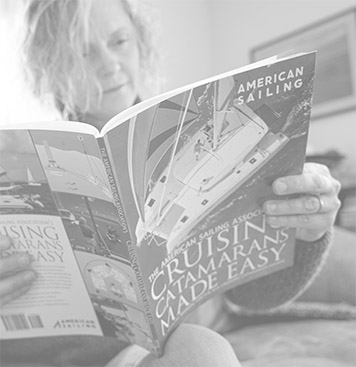
ASA 114 is the one people most often forget exists — until they try to charter a catamaran and find out a monohull-only résumé doesn’t automatically transfer. Catamarans handle differently enough that American Sailing built a dedicated standard around it: twin-engine maneuvering, hull design and rigging differences, capsize risk and avoidance, jackline and safety-harness placement specific to a catamaran’s deck layout, and man-overboard recovery adapted to a boat that distinct behavior from that of a monohull under sail or power. If a catamaran charter is the destination, this certification isn’t optional — it’s the one that actually covers the boat you’re planning to sail.
| Certification | Vessel Size | Conditions | Prerequisite |
|---|---|---|---|
| ASA 101 | 20–27 ft keelboat | Daylight, ≤15 kt | None |
| ASA 103 | 25–35 ft keelboat | Day, ≤20 kt | ASA 101 |
| ASA 104 | 30–45 ft keelboat | Multi-day, ≤30 kt | ASA 101, 103 |
| ASA 114 | Cruising catamaran | Coastal/offshore | ASA 101, 103, 104 |
Notice that each step increases three things at once: the size of the boat, the harshness of the conditions you’re certified to sail in, and the length of time you’re expected to be self-sufficient aboard. That’s not arbitrary — it mirrors what actually changes as a boat gets bigger and a cruise gets longer. A 27-foot daysailer and a 45-foot 4-cabin vessel you’ll live aboard for a week ask genuinely different things of a skipper, and the certification sequence is built to develop those things in order rather than all at once.
Completing all four certifications tells a charter company, and tells you, that you’ve met a defined standard on each vessel type and skill set. It doesn’t, on its own, tell anyone how much of that skill has actually been lived — how many real decisions you’ve made under real conditions, on a boat similar to the one you’ll eventually charter. That’s the gap between “certified” and “charter-ready,” and it’s worth understanding clearly rather than assuming the four certificates close it automatically.
Knowing the pathway is one thing. Knowing where you actually stand on it is another. Our self-assessment checklist walks through the same questions a charter company will ask before handing over the keys.
Related reading:









With Nautilus, your liveaboard course is just the beginning of your sailing journey!
We're here to offer next step opportunities to deepen your sailing knowledge, skills and experience.
Join us on flotillas, offshore deliveries, free webinars and unforgettable sailing adventures around the world. Join the Tribe.
CALENDAR OF EVENTS